SaaS Platform Maintenance & API Strategy: Staying Secure at Scale
Launching your SaaS application is a milestone, but sustaining it is a discipline. Ongoing SaaS platform
maintenance is what keeps the business working after launch day.
As your user base expands, transaction volumes climb. Meanwhile security threats evolve, and customers
start asking for integrations you had not planned. None of these, unfortunately, are one-off problems.
Pair proactive SaaS platform maintenance with a clean, well-documented API strategy. Together they keep
your application stable, secure and genuinely ready to plug into your customers’ toolstacks.
Why SaaS Platform Maintenance Never Really Stops
Maintenance is not just fixing bugs after a customer reports them. Instead, it is a continuous practice
covering monitoring, security and infrastructure tuning.
Most of that work should be invisible. Done well, your product simply keeps working, and nobody outside
the team notices the effort behind it.
The Four Pillars of Proactive SaaS Platform Maintenance
A mature programme rests on four pillars.
Security Patching and Vulnerability Scanning
First, update third-party dependencies regularly and apply server patches promptly. Then run routine
security audits against a known baseline such as the OWASP Top 10. Most breaches exploit vulnerabilities
that already had a patch available. In other words, the failure sits in the process rather than the code.
Performance and Database Optimisation
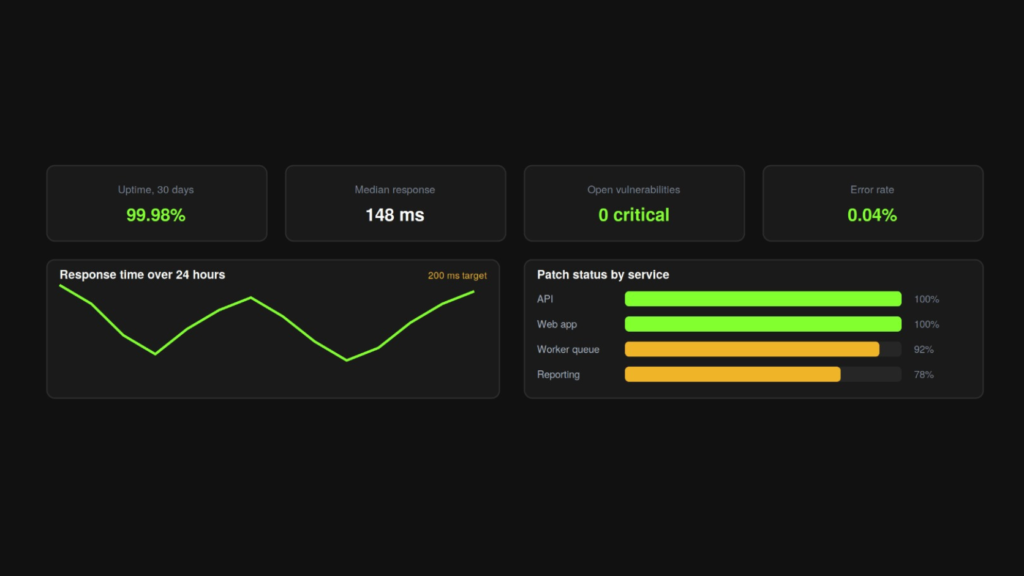
Second, watch for slow queries, tune your indexes and add caching layers such as Redis. Aim to hold
response times under 200ms as usage grows. Google’s Core Web Vitals also give you a useful front-end
benchmark alongside your server metrics.
Zero-Downtime Deployments
Third, ship updates through rolling or blue/green deployments. Releases should never interrupt an active
session. Ideally, customers cannot tell when you deploy at all.
Real-Time System Health Monitoring
Finally, set up automated alerts with Datadog, Sentry or Prometheus. Your team should catch anomalies
first, because learning about an outage from a customer email is a process failure.
Building a SaaS Platform Maintenance Schedule That Runs Itself
Good maintenance is scheduled rather than remembered. Therefore give each task a fixed cadence and a
named owner
Building a SaaS Platform Maintenance Schedule That Runs Itself
Good maintenance is scheduled rather than remembered. Therefore give each task a fixed cadence and a
named owner.
Cadence
Continuous
Weekly
Monthly
Quarterly
Annually
Tasks
Automated dependency scanning, uptime checks, error alerting
Patch review, backup verification, error-rate triage
Slow-query review, index tuning, cost and capacity check
Security audit, dependency major-version upgrades, disaster-recovery drill
Penetration test, architecture review, compliance renewal
Write the schedule down, and put it in your issue tracker. Otherwise a cadence that lives only in someone’s
head stops running the moment that person takes leave.
Building a Scalable API Strategy Alongside SaaS Platform
Maintenance
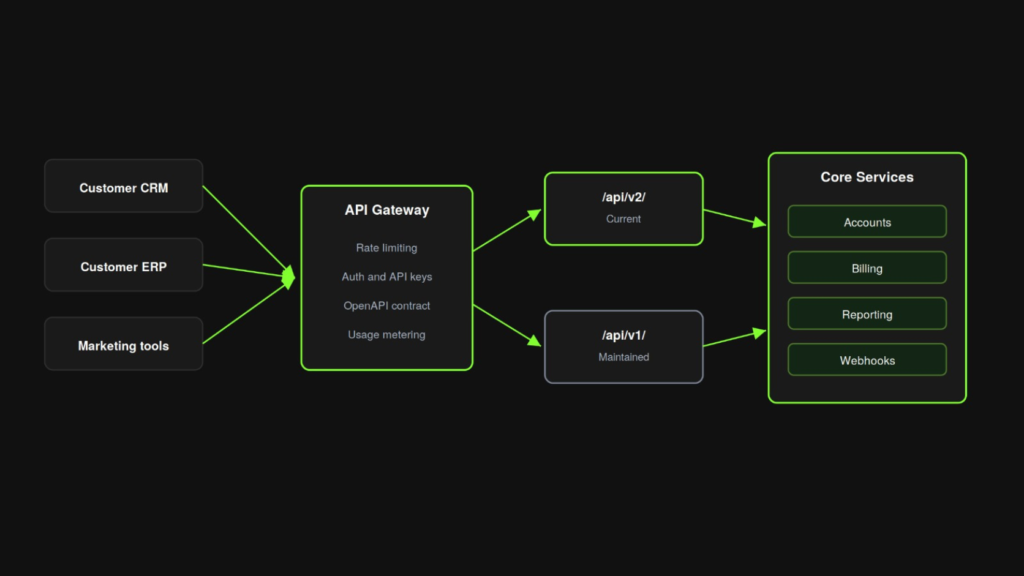
Isolated software products rarely survive in modern cloud ecosystems. Customers now expect your
platform to connect to their CRM, ERP and marketing tools.
As a result, your API belongs in the maintenance plan as a first-class concern rather than an afterthought.
Standardise API Protocols
Build clean RESTful APIs or GraphQL endpoints, then document them against the OpenAPI Specification.
Consistent response schemas make developer onboarding much easier.
Enforce Rate Limiting and Throttling
Protect your backend from abuse and traffic spikes. Apply token-bucket limits per API key or IP address. In
addition, return clear headers so clients can back off gracefully.
Adopt Robust Versioning Policies
instead. Legacy clients then keep running while newer iterations ship alongside them.
Invest in Documentation and Developer Experience
Publish interactive docs, a sandbox environment and SDK wrappers in your customers’ main languages.
Keep a public changelog too. Good developer experience shortens integration projects from weeks to
days, and it frequently wins enterprise deals.
Incident Response as Part of SaaS Platform Maintenance
Outages happen to every platform eventually. What separates mature teams is how quickly and calmly
they respond.
Define severity levels: agree in advance what counts as critical, major and minor. Then everyone
escalates consistently under pressure.
Keep an on-call rotation: one named person owns each shift, and the roster is published. Ambiguity
costs minutes you cannot spare.
Publish a status page: customers tolerate downtime far better when they can see you are on it.
Silence, by contrast, drives support tickets.
Run blameless post-mortems: document the timeline, the root cause and the fix. Then feed each
action item back into your maintenance schedule.
Practise the process before you need it. A recovery drill each quarter, for instance, surfaces gaps while the
stakes are still low.
Managing Technical Debt Without Stalling the Roadmap
Every shipped feature adds a little debt. Ignore it, and your delivery speed drops quarter after quarter.
The practical fix is a standing allocation. Reserve fifteen to twenty percent of each sprint for refactoring,
test coverage and dependency upgrades. Then protect that allocation the way you protect feature work.
Keep a visible debt register as well. Record what the shortcut was, what it costs you now, and what fixing it
would take. Debt you can see gets prioritised. Debt in someone’s memory, on the other hand, does not.
How Often Should SaaS Platform Maintenance Happen?
Security patching and dependency updates belong on a continuous or weekly cadence. Deeper
performance audits and infrastructure reviews, meanwhile, suit a monthly or quarterly rhythm.
Your exact schedule depends on traffic and compliance obligations. Even so, the principle stays the same.
This works best as a standing process rather than an occasional fire drill
Questions & Answers
How much should ongoing maintenance cost per month?
Many teams budget fifteen to twenty-five percent of the original build cost per year. The figure varies with
compliance requirements and growth rate. Security-heavy or regulated products, for example, sit at the
higher end.
What is the difference between REST and GraphQL for a SaaS API?
REST exposes fixed endpoints per resource, and it is simple to cache and document. That is why it
remains the default choice. GraphQL, by contrast, lets clients request exactly the fields they need from one
endpoint. It suits complex, data-heavy integrations, although it adds implementation overhead
How do I know if my API needs versioning yet?
If external customers or partners consume your API, you need versioning now. The moment a breaking
change could disrupt someone else’s integration, unversioned endpoints become a business risk rather
than a theoretical one.