Building a Scalable Multi-Tenant SaaS Architecture: A 2026 Guide
A well-planned multi-tenant SaaS architecture separates platforms that scale smoothly from those that
buckle under growth. First, it shapes how quickly you onboard new customers. Second, it decides how
safely tenant data stays isolated. Finally, it sets what each extra user costs you to serve.
Multi-tenancy lets one instance of your software serve many customers at once, and each customer is
called a tenant. Tenants share the same compute and application layer. Even so, they stay logically
isolated from one another. Because infrastructure is shared rather than duplicated, your running costs stay
low as your customer base grows.
This guide covers the core models of multi-tenant SaaS architecture. In addition, it walks through the
database strategies behind each one. It also sets out the engineering practices that keep tenant data
secure at scale
How Multi-Tenant SaaS Architecture Works
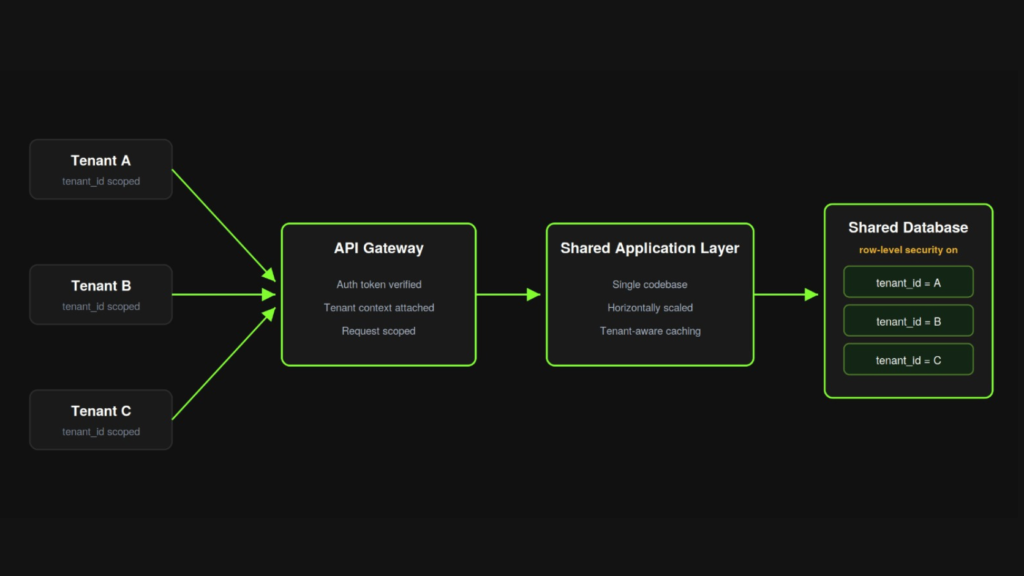
Multi-tenant SaaS architecture is a design pattern in which one application instance serves many customer
organisations. As a result, each tenant’s data, configuration and usage stay logically separate.
This differs from running a separate copy of your software for every client. Instead, you run one codebase
and one set of servers. Often you run a single database as well. Even then, no tenant can ever see
another tenant’s information.
Most modern SaaS products use this model, because it cuts infrastructure overhead sharply. For example,
you do not provision new servers for every signup. You scale the shared platform horizontally instead. Your
architecture then routes each request to the correct tenant context automatically
Single-Tenant vs Multi-Tenant SaaS Architecture: Key Differences
Before you design your cloud environment, it helps to understand how multi-tenancy differs from traditional
single-tenant hosting.
Single-tenant architecture: every customer gets a dedicated software instance, database and
infrastructure block. It is highly secure, and it is easy to customise per client. However, it is expensive
to maintain and hard to scale past a few dozen customers.
Multi-tenant architecture: many clients share the same servers and application instances. Because
updates apply to everyone at once, infrastructure overhead falls and your release cycle speeds up
considerably.
For most providers, therefore, a multi-tenant SaaS architecture is the standard choice. It delivers healthier
margins and faster deployment. Single-tenant setups still suit large enterprise clients with strict compliance
or data-residency rules. For the majority of B2B and B2C products, though, multi-tenancy wins on both
cost and speed.
Core Database Strategies for Multi-Tenant SaaS Architecture
Your database pattern is the most important decision in multi-tenant system design, since it affects
security, query performance and running cost directly. Microsoft’s multitenant architecture guidance covers
the same three patterns in depth. Read it alongside this section if you want the deeper version.
1. Shared Database, Shared Schema
Here every tenant shares the same database and the same tables. Rows are separated by a tenant_id
column.
Pros: very cost-effective, simple to maintain, and easy to run cross-tenant analytics on.
Cons: you need strict isolation rules at query level, because one missing filter can leak data between
customers.
2. Shared Database, Separate Schemas
In this model tenants share a database instance, but each one gets its own schema. Tables are therefore
partitioned logically per client.
Pros: stronger isolation than a shared schema, with simple per-tenant database permissions.
Cons: migrations get slower as schema count climbs into the hundreds
3. Separate Databases Per Tenant
Finally, each tenant can get a fully isolated database while the application tier above it stays shared.
Pros: maximum security, easy per-customer backup and restore, and straightforward compliance for
regulated industries.
Cons: hosting costs rise sharply, and schema updates need a proper orchestration pipeline.
Architectural tip: Let your target industry guide the choice. Enterprise B2B products usually need separate
schemas or databases. Lightweight B2C platforms, in contrast, do well on a shared schema.
Choosing the Right Model for Your Multi-Tenant SaaS Architecture
In practice, three questions settle most of these decisions.
Do any customers have data-residency obligations? If so, you need separate databases for at least
those accounts.
How large is your average tenant? Thousands of small tenants suit a shared schema. A few dozen
large ones, on the other hand, suit separate schemas.
How often will you ship schema changes? Frequent migrations favour a shared schema, because you
only run each change once.
Hybrid models are common, and they are perfectly valid. For instance, many platforms keep small
accounts on a shared schema, then move enterprise clients onto dedicated databases as they grow. Your
multi-tenant SaaS architecture does not have to treat every customer identically

Key Principles for Secure Tenant Isolation
Data leakage between tenants is the worst incident a SaaS provider can face, because it destroys
customer trust instantly. For that reason, build these safeguards in from the start.
Middleware-Based Tenant Context
Use API gateway or framework middleware to inspect the auth token on every request. Then attach the
verified tenant_id to the request context before your business logic runs. As a result, no downstream code
can query data without a tenant scope.
Row-Level Security at the Database Layer
Next, enforce isolation at the database engine itself. PostgreSQL row-level security is the usual choice
here. Queries then scope to the active tenant automatically, even if an application-level filter is missed. In
other words, it is a genuine safety net rather than a duplicate check.
Tenant-Aware Caching
Finally, prefix every Redis or Memcached key with the tenant ID, such as tenant_102:user_5. This stops
cache contamination between organisations. A single unprefixed key is a surprisingly common cause of
cross-tenant leaks in production.
Common Pitfalls When Scaling Multi-Tenant SaaS Architecture
Even well-designed platforms hit predictable problems as tenant count grows. Catching these early,
however, saves considerable rework later.
The noisy neighbour problem: one high-traffic tenant can monopolise shared compute or database
connections. Per-tenant rate limiting and connection pooling contain it.
Inconsistent tenant_id enforcement: background jobs and cron tasks often skip the middleware
layer. Therefore every code path needs the same enforcement, not just the web tier.
Migration bottlenecks: a schema change across thousands of tenants can take hours. For that
reason, plan backward-compatible migrations from day one.
Thin monitoring: without per-tenant observability, you cannot tell whether a slowdown affects one
customer or everyone
Questions & Answers
Is multi-tenancy more secure than running separate instances?
Not automatically, because security depends on how well isolation is enforced rather than on the model
itself. A multi-tenant SaaS architecture with row-level security and middleware enforcement can match
single-tenant hosting. In fact it is often better, since every tenant benefits from the same hardened,
continuously patched codebase.
How many tenants can one database realistically handle?
That depends on the pattern you pick. A shared schema comfortably supports tens of thousands of small
tenants. Separate-schema and separate-database models, by contrast, usually top out in the hundreds or
low thousands before operational overhead becomes a burden
Should a new SaaS startup build for multi-tenancy from day one?
Usually yes, at least at the application layer. Retrofitting tenant isolation into a single-tenant codebase later
is far more disruptive than designing for it upfront. That holds true even if your first customers all sit on one
shared database