SaaS MVP Development: The Complete Guide From Idea to Launch

Speed to market decides a great deal in cloud software. That is why SaaS MVP development has become
the default starting point for founders and product teams. A minimum viable product is a stripped-back
version of your software, and it contains only the features needed to solve one specific problem for early
adopters.
The alternative is spending months building a full feature set in isolation. Effective SaaS MVP development
avoids that trap. Instead, it lets you validate your value proposition, win your first paying customers and
gather real usage data. Crucially, all of that happens before you commit serious budget to features nobody
may want.
What Is a SaaS MVP, and Why Does It Matter?
A SaaS MVP is not a lesser or unfinished product. Rather, it is a fully working product with a narrow scope,
and it solves one core problem exceptionally well.
The goal of SaaS MVP development is not to ship less software. It is to ship the right software first. You
then learn what to build next from real customers instead of guesswork.
This matters because software is expensive to build, and the wrong software is the most expensive
mistake a SaaS company can make. An MVP, therefore, is a fast and low-risk way to test your core
hypothesis. The lean startup principles that popularised the approach still hold up well today.
Why Most SaaS MVP Development Projects Fail
Building an MVP sounds simple. In practice, however, teams fall into the same handful of traps.
Feature creep: packing in features before validating the primary problem. Good SaaS MVP
development stays fixed on one core workflow instead.
Over-engineering: building custom infrastructure for non-core functions. Lean on reliable third-party
APIs rather than reinventing them.
Ignoring core UX: an MVP should be simple, but it should never feel broken. Therefore keep the main
flow polished, even if the feature set is small.
Skipping analytics: launching without instrumentation means you learn nothing from early users,
which defeats the whole point.
A Step-by-Step Framework for SaaS MVP Development
The framework below is the one we use at Web Matrix Lab when guiding founders from a blank page to a
working product.
Step 1: Define the Single Core Problem
First, identify the one pain point your software solves. Suppose your platform promises to automate
invoices, optimise marketing and manage inventory. Narrow that to the single most acute problem for
launch. You can always expand later.
Step 2: Map the Core User Flow
Next, write out the exact sequence a user follows from signup to real value. Then remove every non
essential step. Some of them will feel important. Even so, they can wait for version two.
Step 3: Choose a Lean, Proven Tech Stack
Use high-productivity frameworks such as Next.js, React and Node.js, paired with a managed relational
database. In addition, pre-built authentication services and a modular UI system will shorten your delivery
timeline noticeably. Avoid novel technology at this stage, because debugging it costs time you do not have.
Step 4: Instrument Analytics and Feedback Loops
Add telemetry from day one with a tool such as PostHog or Mixpanel. You need to see how early adopters
move through your product. More importantly, you need to see where they drop off.
Step 5: Launch, Measure and Iterate
Finally, ship to a small group of real users as early as you can. Treat every release after that as a feedback
loop. Measure what works, cut what does not, and let usage data drive the roadmap rather than internal
opinion.
Product manager tip: Your MVP is an experiment designed to answer a business question. It is not simply
a smaller version of the final product. Therefore build only what you need to test the core hypothesis with
real users.
How to Measure SaaS MVP Development Success
Sign-ups are a vanity metric. These four numbers, on the other hand, tell you whether the product actually
works.
Activation rate: the share of new users who reach the core value moment. Below 25% usually means
your onboarding is too long.
Week-four retention: how many users are still active a month after signup. This is the clearest early
signal of product-market fit.
Time to value: how long a new user takes to get their first useful result. Shorter is nearly always
better.
Willingness to pay: conversion from trial to paid. Free usage tells you far less than a card on file.
Set a target for each one before launch. Otherwise you end up deciding what success looks like
afterwards, which invites wishful thinking.
What to Leave Out of Your First Release
Deciding what to cut is harder than deciding what to build. Nevertheless, these features can almost always
wait.
Admin dashboards: run reports from the database directly at first. Building internal tooling before you
have customers is premature.
Role and permission systems: a single user type is usually enough to prove the concept. Granular
roles come with enterprise demand.
Native mobile apps: a responsive web app validates the idea at a fraction of the cost. Only build
native once retention justifies it.
Deep integrations: start with a CSV import and one webhook. Full CRM connectors can follow after
you know which ones customers ask for.
In short, each of these adds weeks to the build. None of them answers the question your SaaS MVP
development project exists to answer.
How Long Should SaaS MVP Development Take?
Most successful projects run six to twelve weeks from kickoff to a usable first release. That assumes a
tightly scoped feature set and a small, focused team.
Timelines stretch, however, as soon as scope creeps past a single core workflow. This is exactly why step
one matters so much. Teams that resist adding one more feature before launch consistently ship faster and
learn faster

Transitioning From MVP to a Full-Scale SaaS Platform
Once your MVP wins its first paying customers, the focus shifts. Validation gives way to retention and
expansion.
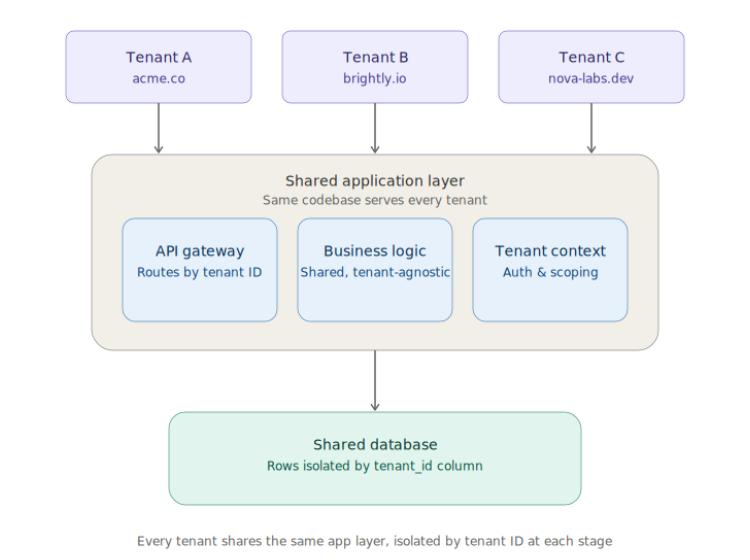
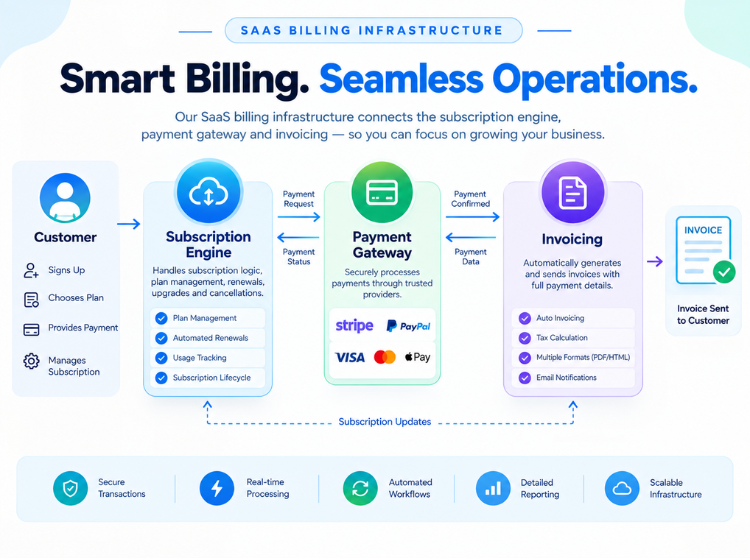
At that point the technical debt from rapid prototyping needs refactoring into a scalable platform. In practice
that means the multi-tenant architecture and billing infrastructure covered elsewhere in this series.
How Web Matrix Lab Supports SaaS MVP Development
A market-ready MVP needs technical precision, fast execution and clean interface design in equal
measure.
Our MVP Development & Launch service helps founders turn raw ideas into working, revenue-generating
platforms quickly. We cover UI design, backend architecture and payment integration, all as part of our full
SaaS development services.
Questions & Answers
How much does SaaS MVP development typically cost?
Cost varies widely with scope. A tightly focused MVP costs far less than a full platform build, because you
deliberately limit the feature set to one workflow. Integrations, compliance requirements and team location
move the figure most.
What is the difference between an MVP and a prototype?
A prototype is usually a non-functional mockup, and you use it to test an idea internally or with a handful of
users. A SaaS MVP, by contrast, is a real working product that paying customers can get value from. The
bar is functional, not merely visual
Do I need a full engineering team for SaaS MVP development?
Not necessarily. Many successful projects start with a small senior team or an experienced development
partner instead. After all, the goal at this stage is speed and focus rather than headcount.