Brand Strategy: Building a Brand With a Reason to Exist
Most brands that feel forgettable were never actually positioned. Somebody picked colours and a tagline, and called it a brand strategy. It isn’t one.
A real brand strategy answers a harder question first: why should anyone choose you over the next option, and how would they even know to.
This guide covers how to research your position, define a personality that holds up under pressure, and put messaging in place that a whole team can use consistently.
Why Brand Strategy Comes Before Design
Design without strategy produces something that looks nice and says nothing. It is expensive to fix later, because every asset — website, packaging, signage — has already been built on the wrong foundation.
Strategy is not a deliverable teams enjoy waiting for. It is, however, the only part that makes the design phase fast rather than endless, because a clear brief removes most of the back-and-forth.
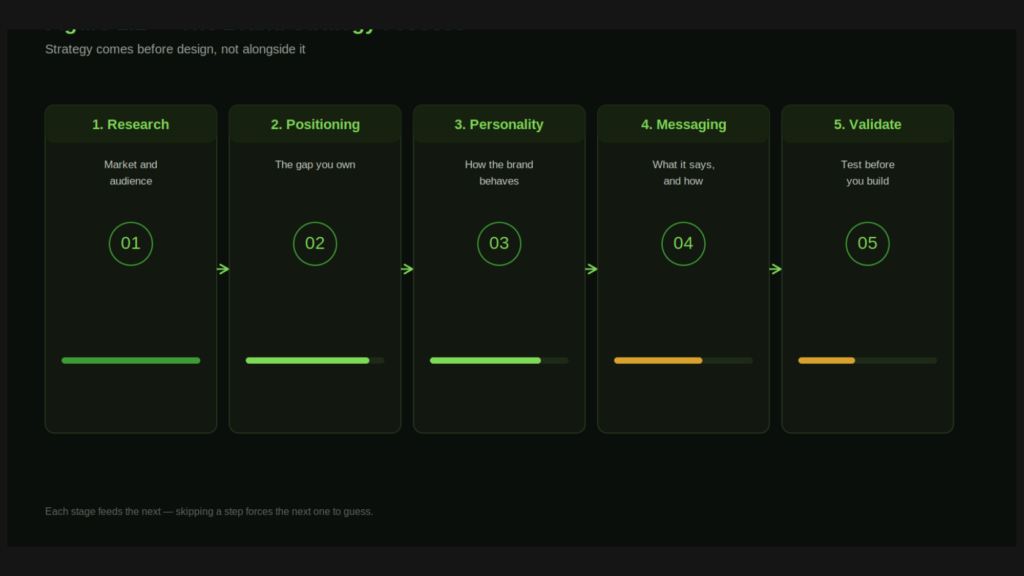
Step One: Understand the Market and the Audience
Start outside your own company. Look at what competitors actually say, not just what they sell, because most categories converge on the same three or four claims.
- Competitive gaps: find the claim nobody else in your category is making credibly.
- Audience language: use the words your customers use, not the words your industry uses internally.
- Buying triggers: understand what actually causes someone to switch providers, since it’s rarely the reason people assume.
- Perception today: if the brand already exists, ask current customers how they’d describe it. The answer is often not what leadership expects.
Step Two: Define Your Positioning
Positioning is one sentence: for this audience, we are the only brand that does this, because of this. Everything else in the strategy supports that sentence.
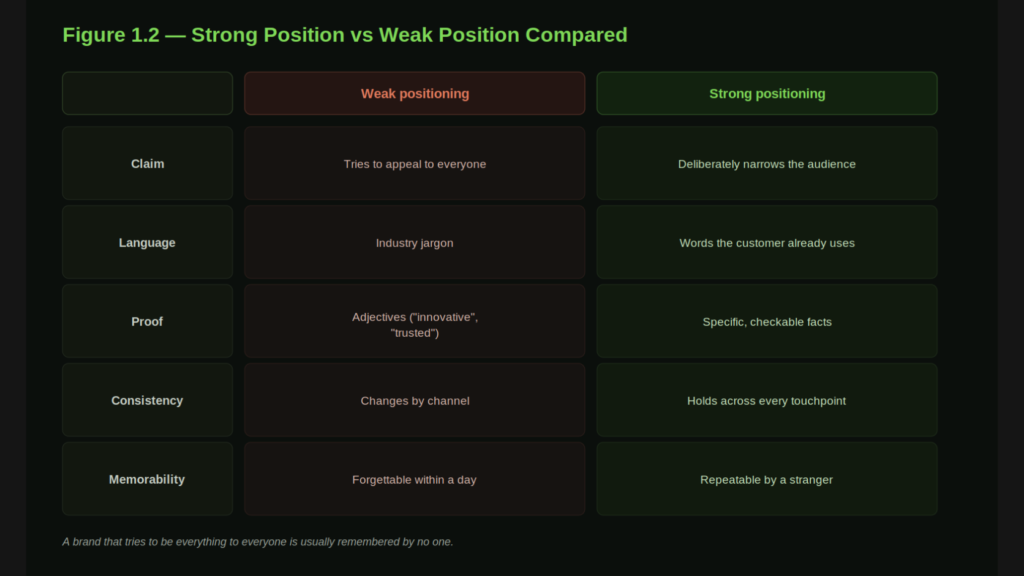
Weak positioning tries to appeal to everyone and ends up meaning nothing to anyone. Strong positioning accepts that it will not be right for some people, and says so clearly.
Step Three: Build a Personality That Holds Up
A brand personality is not a mood board. It’s a set of decisions about how the brand behaves — what it would never say, how it responds when something goes wrong, whether it’s formal or casual under pressure.
Positioning tip: Write down three things your brand will never do or say. Boundaries define a personality far more reliably than a list of adjectives does.
Step Four: Turn Strategy Into Messaging
Messaging translates the strategy into language people actually use — headlines, elevator pitches, the first line of an About page.
- One core message: the single thing you want remembered if nothing else lands.
- Proof points: specific facts that back the message up, not adjectives.
- Audience variants: the same truth, phrased differently for different audiences, without contradicting itself.
- A tone of voice guide: enough detail that two different writers produce consistent copy.
-
-
-
Common Brand Strategy Mistakes
- Skipping research: guessing at audience language produces copy that sounds right internally and lands flat externally.
- Confusing values with positioning: “we care about quality” describes every competitor too.
- Writing strategy nobody can use: a 40-page deck that never becomes a one-page brief helps nobody.
- Designing before deciding: a logo brief written before positioning is settled gets redone at least once.
Validating Strategy Before You Build on It
Test the positioning with real people before committing budget to design. Show the one-sentence positioning statement to five people outside the company and ask what they’d expect the brand to look and sound like. Large gaps between their answer and your intent are worth fixing now, not after launch.
How Web Matrix Lab Approaches Brand Strategy
Strategy work here always precedes design work. We research the market, define positioning with the client in the room, and hand design a brief that answers the hard questions before the first concept is drawn.
Our brand strategy service covers audience research, positioning, personality and messaging. As a result, your visual identity work starts from something solid.
Related reading: visual identity design and rebranding strategy.
Not sure your brand says what you think it says? Book a free consultation and we’ll find out.
-
-
Questions & Answers
How long does brand strategy take?
Two to four weeks suits most projects. Research and positioning take the first half, whilst messaging and validation fill the second.
Do we need a full rebrand to fix our strategy?
Not always. Sometimes the visual identity is fine and only the positioning and messaging need work — a much smaller project.
Can a small business afford proper brand strategy?
Yes, at a scaled-down version. A tight positioning statement and a one-page messaging guide cost far less than a full identity project and prevent expensive design revisions later.