WordPress vs. Shopify: Which Platform is Right for Your Christchurch Business?
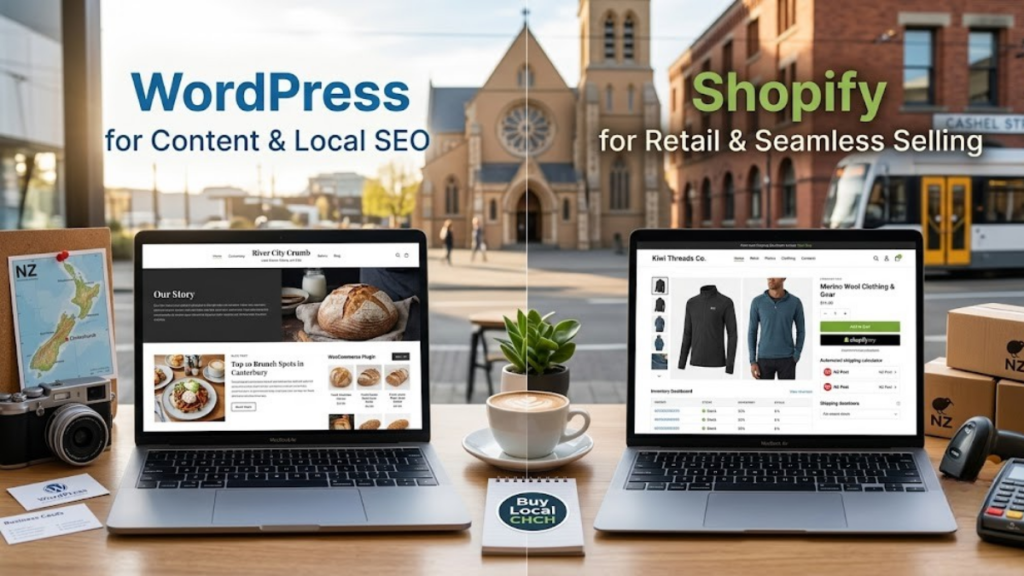
Choosing the right digital foundation is one of the most consequential strategic decisions you will make for your local enterprise. Whether you are running a boutique retail shop down Cashel Street, an artisan food brand in the Garden City, or a specialized trade service across Canterbury, your website platform dictates how easily local customers find you on Google, how seamlessly they navigate your offerings, and ultimately, how many leads or sales you generate.
When evaluating platform options for the New Zealand market, business owners almost always arrive at the ultimate digital showdown: WordPress vs. Shopify.
Both systems are powerful, reliable, and capable of supporting a growing business, but they were built with entirely different philosophies. Choosing the wrong one can lead to bloated costs, restricted search visibility, and constant technical frustration.
This comprehensive guide explores the structural differences, SEO capabilities, maintenance realities, and long-term costs of both platforms, giving you the exact clarity you need to make the right choice for your Christchurch business.

The Core Philosophical Difference: Content-First vs. Commerce-First
Before diving into technical comparisons, it helps to understand what each platform was fundamentally engineered to achieve:
WordPress was built as an open-source content management system (CMS). It powers over forty percent of the entire internet for a reason: it is an absolute powerhouse for custom design, complex blogging structures, service landing pages, and deep search engine optimization (SEO). When paired with WooCommerce, it transforms into a robust online store, but its soul remains tied to content and structural flexibility.
Shopify was built specifically as a hosted e-commerce engine. Everything on Shopify—from its optimized checkout system to its automated inventory tracking—is engineered around selling physical or digital products with minimal technical friction. It is a closed, proprietary system designed for retail efficiency.
Deep-Dive Semantic Comparison for Christchurch Businesses
To determine which platform aligns with your business goals, let’s examine how they perform across the four pillars that matter most to local business owners: search engine optimization, functional flexibility, ongoing maintenance, and total cost of ownership.
1. Search Engine Optimization (SEO) & Yoast Integration
If your growth strategy relies on capturing high-intent organic search traffic from Canterbury customers typing queries into Google, WordPress holds a distinct structural and tactical advantage.
Absolute Control with WordPress: WordPress offers total ownership over technical SEO elements. Using industry-standard optimization tools like Yoast SEO, you can fine-tune your XML sitemaps, customize individual schema markup (which is vital for local Christchurch map packs and rich snippets), manage granular internal linking hierarchies, and optimize exact-match URL slugs without platform interference. Every single line of code can be modified to meet search engine demands.
Structured Limitations with Shopify: Shopify has improved its basic SEO features over the years, allowing you to edit title tags, meta descriptions, and image alt text. However, its rigid underlying architecture forces strict URL structures (such as products or collections into path hierarchies) and restricts deep custom schema markup. While you can rank a Shopify store successfully, achieving hyper-targeted semantic optimization requires significantly more workaround effort compared to WordPress.
2. E-Commerce Capabilities vs. Service-Based Flexibility
Your business model should dictate your platform choice more than anything else. Trying to force a service-based business onto an e-commerce platform—or vice versa—leads to an uphill battle.
Choose Shopify if: You sell a catalog of physical products online. Its inventory management, automated shipping calculator integration designed for New Zealand carriers like NZ Post and CourierPost, secure multi-currency checkouts, and built-in PCI compliance make retail operations effortless from day one. It minimizes administrative overhead so you can focus on fulfillment and product curation.
Choose WordPress if: Your business offers local services, trades, professional consulting, or a hybrid model combining informational content with bookings, portfolios, or digital product sales. WordPress allows you to scale custom post types, interactive service calculators, booking plugins, and localized landing pages infinitely. If your primary goal is generating phone calls, consultation bookings, or quote requests rather than immediate online cart checkouts, WordPress wins comfortably.
3. Setup, Maintenance, and Local Support
Every business owner must account for the time and financial investment required to keep a website secure, fast, and updated.
Shopify (Fully Managed SaaS): You pay a predictable monthly subscription fee, and Shopify handles server uptime, SSL certificates, software updates, and security patches automatically behind the scenes. Furthermore, you get 24/7 global customer support. The downside? You are renting space on their ecosystem. If they change their terms or raise fees, you have limited recourse.
WordPress (Self-Hosted Open Source): You purchase separate web hosting (ideally utilizing local or Australian server data centers to ensure fast load times for users in Christchurch). You or your web partner are responsible for managing plugin updates, security hardening, and regular backups. While this requires more active management, it gives you 100% data ownership with zero platform lock-in or forced transaction fees on your sales.
Summary Verdict: Which Should You Choose?
| Evaluation Criteria | WordPress (with WooCommerce) | Shopify |
| Primary Use Case | Service businesses, local contractors, blogs, custom content, hybrid models | Pure product-based e-commerce retail stores |
| SEO & Schema Control | Maximum flexibility (Full Yoast SEO capability) | Moderate (Good basics, rigid URL structure) |
| Ease of Use | Moderate learning curve requiring basic oversight | Beginner-friendly drag-and-drop setup |
| Hosting & Ownership | Self-hosted (Complete data ownership, no platform lock-in) | Fully hosted SaaS (Rented infrastructure, proprietary ecosystem) |
| Financial Structure | Hosting + plugin renewals + developer setup | Monthly subscription + app subscription fees + transaction fees |
Go with Shopify if you are launching an online retail storefront, have a large physical product inventory, and want a secure, hassle-free checkout system where you can start selling products immediately.
Go with WordPress if your Christchurch business relies heavily on local SEO dominance, educational content marketing, specialized service pages, and deep structural flexibility to outrank your competitors in the Canterbury region.
Deciding on the ideal platform is only the first step toward building an online presence that actually drives revenue. If you want expert guidance to handle the technical setup, maximize your local search rankings, and build a high-converting site, explore our professional Christchurch Web Design Services today.
Question: Which platform is better for local SEO in New Zealand?
Answer: For most service-based businesses, WordPress offers superior SEO capabilities due to advanced technical control, granular schema markup implementation, and powerful plugins like Yoast SEO. However, Shopify is exceptional if your primary focus is retail e-commerce.