Website Redesign: Signs It's Time to Upgrade Your Site

Most businesses don’t wake up one day and decide their website needs a redesign. Instead, it happens gradually—a few outdated pages here, a slow loading time there—until one day you realise your site simply isn’t pulling its weight anymore.
The tricky part is knowing exactly when that tipping point has arrived. In this article, we’ll walk through the clearest signs it’s time for a website redesign, so you can make that decision with confidence rather than guesswork—and before an ageing site starts costing you real customers.
Why Timing Your Redesign Matters
Redesigning too early wastes money and effort on a site that didn’t need major changes yet. However, waiting too long can be far more costly, as an outdated website quietly loses customers, rankings, and credibility with every month that passes.
As a result, learning to recognise the right moment to redesign isn’t just a design decision—it’s a business decision with real financial consequences either way.
Quick Self-Assessment: Do You Need a Redesign?
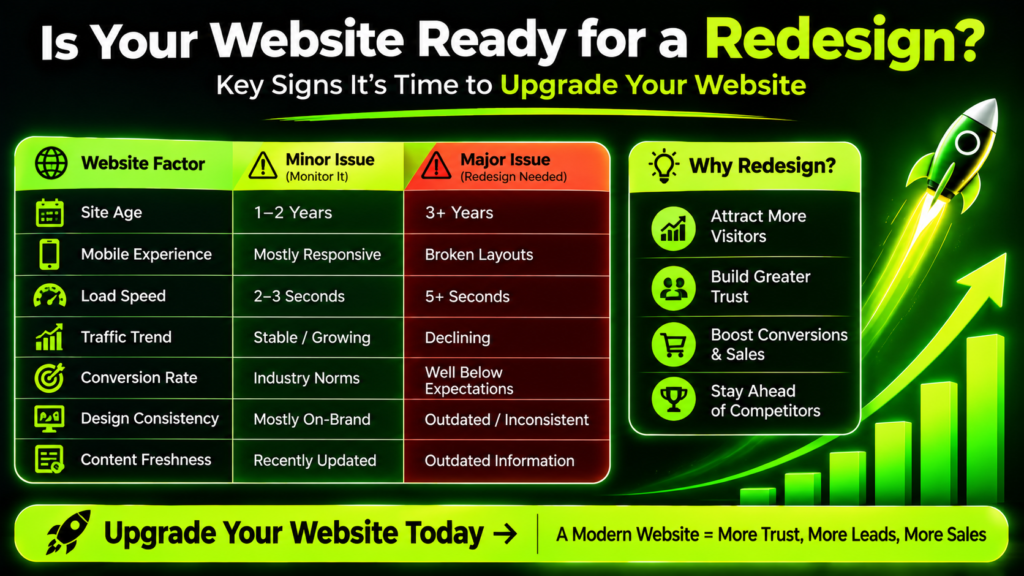
Use this table to get a fast sense of where your website currently stands.
| Sign | Minor Issue (Monitor It) | Major Issue (Redesign Needed) |
|---|---|---|
| Site age | Updated within the last 1–2 years | Untouched for 3+ years |
| Mobile experience | Mostly responsive, minor glitches | Broken layouts, hard to navigate |
| Load speed | Loads in 2–3 seconds | Takes 5+ seconds to load |
| Traffic trend | Stable or slowly growing | Steadily declining month on month |
| Conversion rate | Consistent with industry norms | Well below expected benchmarks |
| Design consistency | Mostly on-brand, minor inconsistencies | Mismatched fonts, colours, and styles |
| Content freshness | Recently updated services or pricing | Outdated information still displayed |
If your website falls into the “major issue” column for two or more of these factors, it’s a strong indication that a redesign should move up your priority list.
1. Your Website Looks Outdated Compared to Competitors
If you’ve browsed your competitors’ websites recently and felt a twinge of embarrassment about your own, that instinct is worth listening to. Visual trends move quickly, and a site that felt modern a few years ago can now look noticeably dated.
Furthermore, an outdated appearance doesn’t just affect aesthetics—it directly shapes how trustworthy and credible visitors perceive your business to be, often within the first few seconds of arriving.
2. It’s Not Optimised for Mobile Devices
If your website was built before mobile-first design became standard practice, there’s a strong chance it isn’t delivering a smooth experience on smartphones. Since mobile traffic now makes up the majority of web visits, this is one of the most urgent redesign triggers.
In addition, Google factors mobile-friendliness directly into search rankings. A site that struggles on mobile isn’t just losing visitors—it’s also likely losing search visibility as a result.
3. Page Load Times Have Become Painfully Slow
Websites naturally accumulate bloat over time: unoptimised images, outdated plugins, and excess code all pile up gradually. If your site has become noticeably slower than it used to be, that’s a clear signal it’s due for a technical and structural overhaul.
However, it’s worth noting that slow speed isn’t always solved by design changes alone—sometimes hosting, coding practices, or media optimisation play just as large a role, all of which a proper redesign process typically addresses.
How to Check Your Site Speed
Free tools such as Google’s own PageSpeed Insights can give you a clear, data-backed view of exactly how your site is performing, along with specific recommendations for improvement.
4. Your Traffic or Conversions Are Declining
A steady drop in traffic or conversions—even while your marketing efforts stay consistent—is often a sign that your website itself has become the bottleneck. Visitors may be arriving but leaving without taking action, or search engines may be gradually deprioritising your outdated site.
As a result, it’s worth reviewing your analytics regularly rather than waiting for a dramatic drop. Catching a downward trend early makes it far easier, and cheaper, to address before it becomes a serious problem.
5. Updating Content Has Become a Technical Headache
If making even simple changes—updating a price, adding a new service, or swapping out an image—requires calling a developer or wrestling with outdated software, that’s a strong sign your website’s underlying platform needs upgrading.
Modern content management systems, such as WordPress, are designed to let business owners make everyday updates themselves quickly and confidently, without needing technical expertise.
6. Your Branding Has Evolved, But Your Website Hasn’t
Businesses naturally evolve—new services, a refreshed logo, an updated tone of voice. However, when your website doesn’t reflect these changes, it creates a disconnect that can confuse or even mislead visitors about who you are today.
A redesign offers the perfect opportunity to bring your entire online presence back in line with your current brand identity, rather than leaving your website stuck in the past.
7. It Doesn’t Reflect What You Actually Offer Anymore
Over time, many businesses expand their services, shift their focus, or discontinue offerings entirely. If your website still highlights outdated services or fails to mention newer ones, potential customers may be forming an inaccurate picture of what you actually do.
This mismatch doesn’t just confuse visitors—it can actively cost you enquiries from customers looking for services you now offer but haven’t clearly showcased.
What a Website Redesign Actually Involves
A redesign doesn’t necessarily mean starting completely from scratch. Depending on your situation, it might involve:
- A full visual and structural overhaul
- Improved mobile responsiveness and page speed
- Updated content reflecting your current services
- Stronger, clearer calls-to-action
- Better SEO structure and technical setup
- A more intuitive navigation and site architecture
A thorough audit at the start of the process helps determine exactly which of these areas need the most attention, ensuring your investment is targeted where it will have the greatest impact.
Making the Case for a Redesign to Stakeholders
If you’re not the sole decision-maker, framing a redesign in terms of measurable business outcomes tends to be far more persuasive than focusing on aesthetics alone. Highlighting declining conversion rates, poor mobile performance, or lost search rankings makes the financial case clear and concrete.
Our team’s website design and UI/UX services can also provide a professional audit, giving you concrete data and recommendations to support that conversation internally.
Final Thoughts: Don’t Wait Until It’s Costing You
An outdated website rarely fails all at once—it fades gradually, quietly costing you customers, rankings, and credibility along the way. Recognising the signs early puts you in control, rather than reacting after the damage is already done.
If any of these signs sound familiar, now is the time to act. Visit Web Matrix Lab to book a professional website audit and discover exactly what a redesign could do for your business. Follow us on Facebook for more tips on keeping your website ahead of the curve.
Questions & Answers
How often should a business redesign its website?
Most businesses benefit from a meaningful redesign every two to three years, though smaller updates and improvements should ideally happen on an ongoing basis in between.
Is a full redesign always necessary, or can I make smaller updates instead?
Not always. If only one or two issues are present, targeted updates may be enough. However, multiple compounding problems usually justify a full redesign for better long-term results.
How much does a website redesign typically cost?
Costs vary widely depending on the site’s complexity and scope, but most small business redesigns range from a few hundred to a few thousand pounds, often paying for themselves through improved conversions.
Will a redesign hurt my existing SEO rankings?
If handled properly—with correct redirects and preserved content structure—a redesign should improve SEO rankings over time rather than harm them. This is an important area to discuss with your design team upfront.
How long does a typical website redesign take?
Most small business redesigns take between three and eight weeks, depending on the scope of work and how quickly feedback and content are provided during the process.